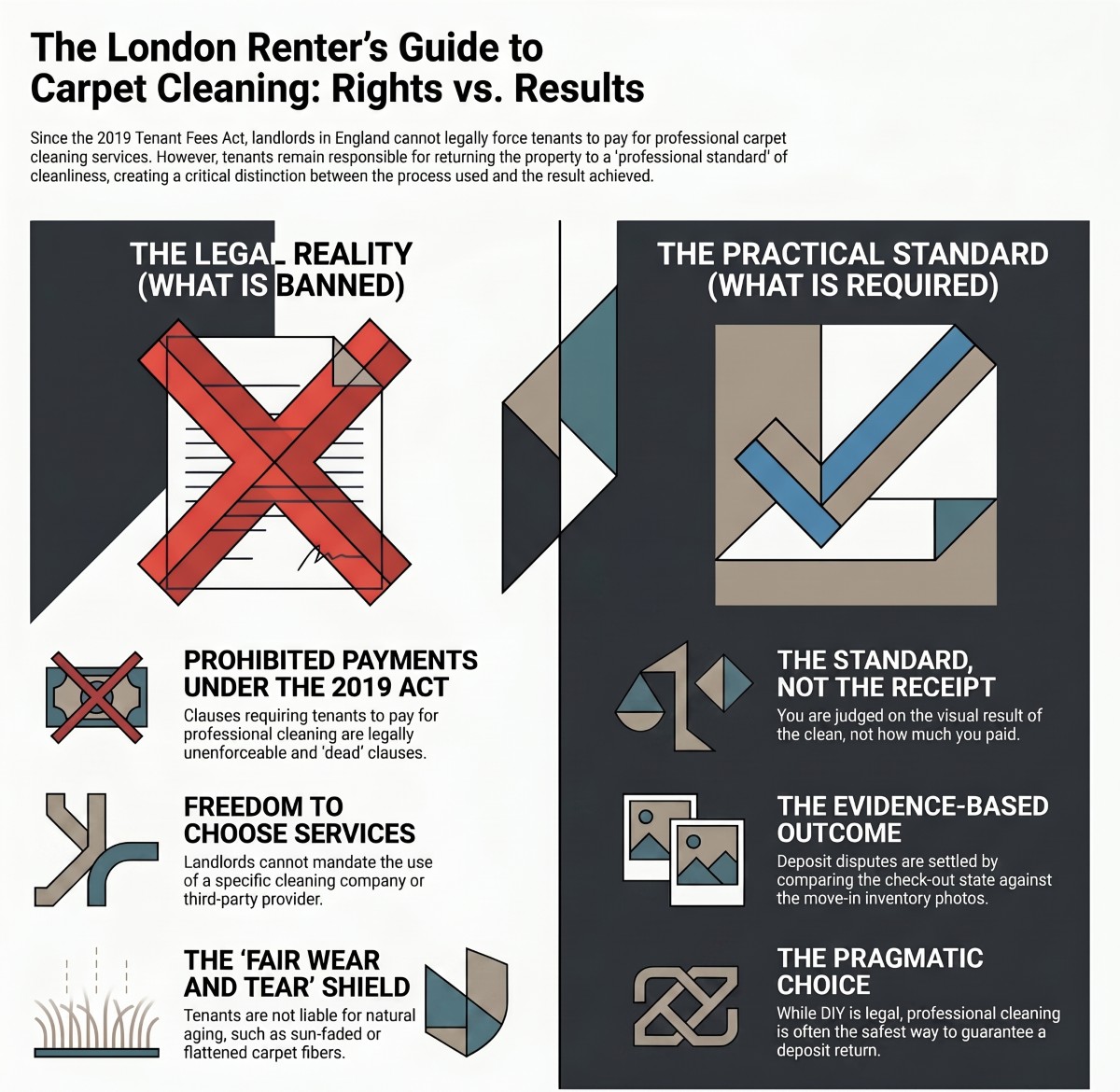
It’s a line that has caused more end of tenancy stress than almost anything else I come across. You’re packing up, counting down to the final inspection, and you reread your tenancy agreement only to find a clause insisting you pay for the carpets to be professionally cleaned before you hand back the keys. With a deposit on the line and the cost of a move to find, the last thing anyone wants is another bill landing on the mat.
Here’s the thing most London renters don’t realise: that clause almost certainly can’t be enforced. A landlord or agent cannot legally make you pay for a professional carpet clean. And yet, this is where it gets interesting, they absolutely can hold you to a professional standard of cleanliness when you leave. The two facts sound like they contradict each other, but they sit right at the heart of getting your deposit back in one piece, so let me untangle them.
The Short Answer: No, They Can’t Make You Pay
What the Tenant Fees Act Changed
For years it was completely standard for tenancy agreements to include a clause requiring the tenant to pay for a professional clean, carpets included, at the end of the tenancy. Plenty of agents still slip it in today. But since the Tenant Fees Act came into force in 2019, that requirement has been what the law calls a prohibited payment, which is the formal way of saying it’s banned outright. The rules applied to all new tenancies from June 2019 and to every existing tenancy in England from June 2020, so there’s no version of a current agreement where it still stands.
The same law says a landlord can’t make you use a particular cleaning company either. So if your agent hands you a list and tells you to book one of “their” cleaners, you’re well within your rights to say no thank you. I’m a carpet cleaner and not a solicitor, but this corner of the law is about as clear as it gets, and it’s worth every renter knowing it.
The Clause That’s Quietly Unenforceable
Here’s the part that catches people out. A clause can sit there in black and white in a signed agreement and still mean absolutely nothing. If it contradicts the law, it isn’t binding, no matter how official it looks or how firmly an agent insists on it. A requirement to pay for professional carpet cleaning is exactly that kind of dead clause. You signed it, yes, but it can’t be enforced against you, and a landlord who tries to dock your deposit purely for refusing to pay a professional cleaner is standing on very shaky ground indeed.
The Catch: You Still Have to Hit a Professional Standard
“A Professional Standard” Is Not the Same as “A Professional”
Now for the twist that trips nearly everyone up. While a landlord can’t make you pay a professional, they can require you to return the property cleaned to a professional standard. The government’s own guidance spells it out plainly: you can be asked to leave the place cleaned to that standard, you simply can’t be forced to pay a third party to do it for you.
Read that carefully, because the whole thing hinges on it. The obligation is about the result, not the receipt. Nobody can dictate how you get the carpets clean – by hand, by hired machine, by professional, or by sheer elbow grease – but they can absolutely judge the state you leave them in. And a professional standard, as the name suggests, is a high bar to clear.
Clean Is One Thing, Wear Is Another
It’s worth knowing exactly where that bar stops, because landlords don’t always draw the line in the right place. You’re responsible for cleanliness, not for the natural ageing of the carpet. There’s no “fair wear and tear” allowance when it comes to dirt – a carpet should be clean when you leave, even an old one – but there very much is an allowance on the wear itself.
A carpet that’s gone a little flat in the doorways, or faded where the afternoon sun hits it by the window, across a three-year tenancy, is fair wear and tear. That’s the landlord’s cost to carry, not yours, and it can’t be quietly dressed up as a cleaning charge. Genuine damage or genuine filth is your responsibility. The slow march of time is not.
Why Doing It Yourself Rarely Clears the Bar
What a Check-Out Inspection Actually Looks At
I’ve seen a good few check-out inspections from the cleaner’s side of things, and they tend to be more thorough than tenants expect. The inspector compares the carpet against the inventory photos taken on the day you moved in. They look at the traffic lanes, the worn spots in front of the sofa and under the dining table, the edges, the corners, and any stain that’s quietly appeared somewhere along the way. A quick once-over with the upright vacuum doesn’t come anywhere close.
The Hired-Machine Trap
This is where a lot of well-meaning renters come unstuck. They hire one of those supermarket carpet machines the weekend before they hand the keys back, give the carpet a thorough soaking, and assume the job is done. More often than not, it looks worse a day or two later.
Those machines lay down a great deal of water and detergent and recover far too little of it. In London, where the water is exceptionally hard, that leftover detergent bonds with the minerals and dries into a sticky residue that actually attracts dirt rather than removing it. Worse still, all that moisture sinks down and can drag old stains back up to the surface as it slowly dries – we call it wick-back – so a carpet that looked spotless on Sunday has faint brown rings by Tuesday, right as the inspector turns up. I’ve been called out by more than one tenant in a flat panic after a DIY clean made things visibly worse the day before check-out.
How Deposit Disputes Are Really Settled
The Inventory Is Everything
If there’s a disagreement, it doesn’t come down to who argues the hardest. It comes down to evidence. Your deposit should be held in a government-backed protection scheme, and if the landlord wants to make a deduction for cleaning, the burden falls on them to justify it – with the check-in inventory, dated photographs, and receipts for any work they’ve had done.
This is why the inventory you barely glanced at on move-in day is the single most important document you have. If it shows clean carpets at the start and they’re grubby at the end, you’re exposed. If it’s vague, or there are no decent photos, the landlord will struggle to prove their case at all. Take your own time-stamped photos on the way out, too. They’ve settled many a dispute in the tenant’s favour.
If It Goes to Adjudication
Should it reach a formal dispute, the deposit scheme offers free adjudication, and an independent adjudicator weighs up the evidence from both sides. They are well used to landlords overreaching. They won’t allow a charge for fair wear and tear, they won’t enforce a banned professional-cleaning clause, and they won’t take an unsupported claim at face value. But they will side with a landlord who has a clear inventory showing carpets that were clean on arrival and dirty on departure. Evidence wins, every single time.
So What’s the Sensible Move?
Here’s where the two halves of all this finally come together. You can’t be forced to pay for a professional, but you can be held to a professional standard, and as we’ve seen, hitting that standard yourself is genuinely hard. A hired machine often makes matters worse, the hard water works against you, and the inspector is quietly comparing your efforts to a professional finish.
So for a great many renters, paying for a professional clean ends up being the pragmatic choice – not because anyone forced their hand, but because it’s the most reliable way to protect a deposit that’s usually worth far more than the cost of the clean itself. You also come away with an invoice, which is tidy evidence that the carpets were done properly. The real difference is that it becomes your decision, made with the facts in hand, rather than a charge forced on you by a clause that was never enforceable to begin with.
For others – a short tenancy, fairly new carpets, a bit of time and the right approach – a careful job of your own is perfectly enough. There’s no single right answer here. There’s only knowing where you genuinely stand.
The Bottom Line
The next time you spot that clause in a tenancy agreement, you can read it for what it actually is: unenforceable. No landlord or agent in England can make you pay for professional carpet cleaning, full stop. What they can do is expect the carpets back at a professional standard, and lean on the inventory to prove their case if they aren’t.
Knowing the difference puts you back in control. Clean to the standard, keep your evidence in order, and decide for yourself whether to pick up a hired machine or hand the job to someone who does it for a living. Either way, you’ll be making the choice on your own terms – which is exactly how it ought to be.