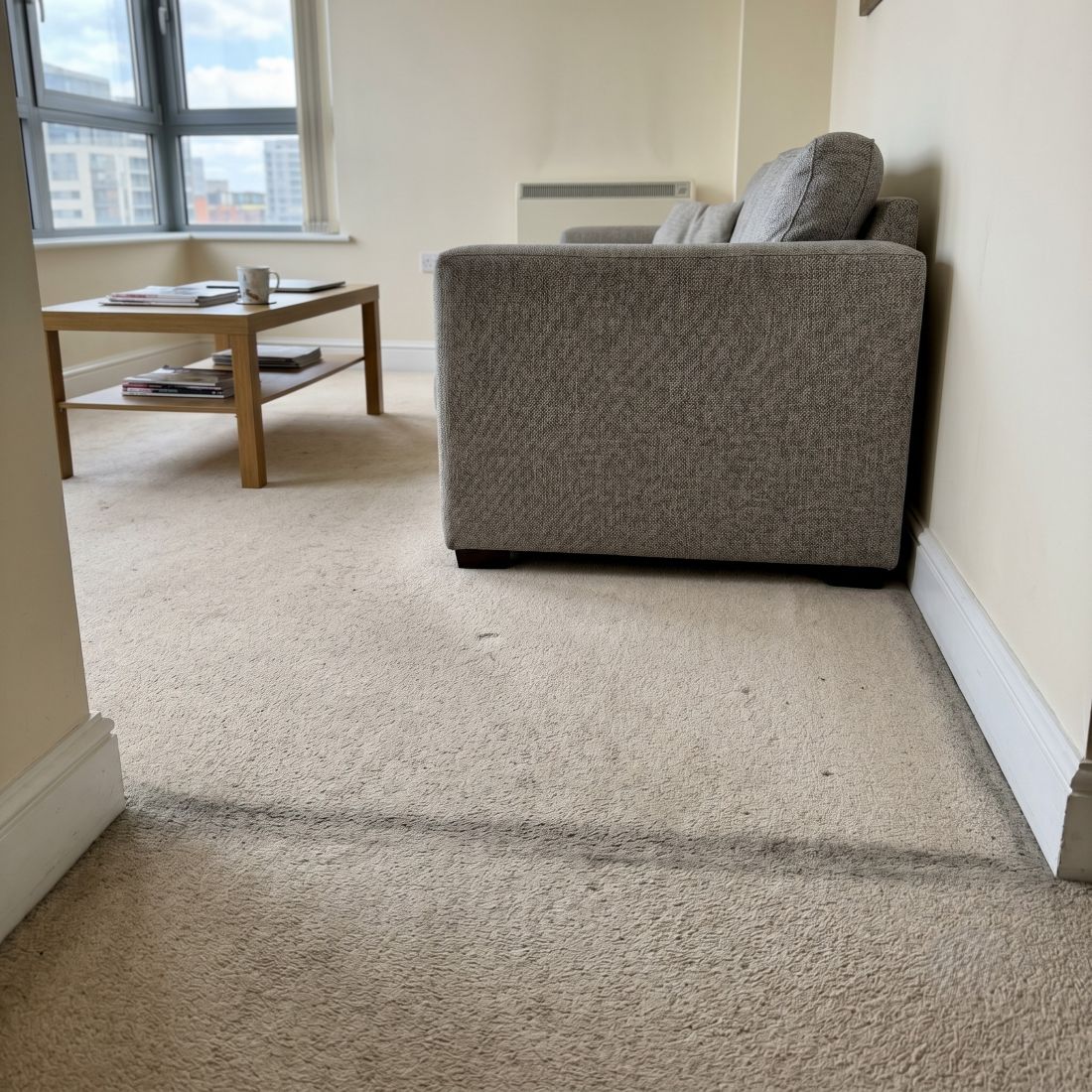
There’s a moment I’ve seen on more London doorsteps than I can count. A customer runs a hand across a freshly cleaned carpet, pauses, and says something like, “It’s clean, but it doesn’t feel clean.” The colour has come up nicely, the stains have gone, yet the pile feels faintly rough underfoot and the whole thing looks a touch flat. They usually assume the carpet is simply getting old, or that the clean didn’t quite take. Nine times out of ten, the real culprit is something pouring straight out of their own taps.
London water is hard. Properly hard. Most people connect that with a furred-up kettle or the white spots on a shower screen, but it has just as much to say about the state of your carpets. After years of cleaning floors across the city, I’ve come to treat the local water supply as part of every single job. Ignore it, and even a careful clean can leave a carpet feeling stiffer and looking duller than it ever should.
London’s Water Is Harder Than Most People Realise
What Hardness Actually Means
Water picks up minerals on its journey to your tap. In and around London, that journey runs through thick beds of chalk and limestone, and the water dissolves a fair amount of calcium and magnesium carbonate along the way. Those dissolved minerals are what we mean by “hardness”. The more of them the water is carrying, the harder it is.
Hardness gets measured in parts per million of calcium carbonate, and the rough line for “hard” water sits around 200 parts per million. Anything comfortably above that starts to make itself known around the home – on the taps, in the kettle, and, as I’ll come to, deep in your carpet pile.
Why London Sits Near the Top of the Scale
London sits on the Thames chalk basin, which hands it some of the hardest tap water of any major city in Europe, typically somewhere between 250 and 350 parts per million. To put that in perspective, parts of Scotland enjoy water down around 10 to 40 parts per million – soft as you like, and a world away from what we get down here.
The hardness isn’t even spread across the city, either. The overwhelming majority of London’s boroughs fall into the “very hard” bracket, with Barnet, Enfield and Harrow sitting among the worst offenders. Step just outside the city into somewhere like Epping and the readings climb higher still. But wherever you are in Greater London, the water leaving your taps is quietly doing the same work on your carpet that it does on your kettle.
What Hard Water Does to a Carpet
The Residue That Refuses to Rinse Away
Here’s where it starts to matter for your floors. When you clean a carpet, you’re using some kind of detergent, and detergent has to be rinsed out afterwards. Hard water makes that far trickier than it sounds. The calcium and magnesium in the water react with cleaning products and form a stubborn, insoluble residue – the carpet equivalent of that grey scum you see clinging to the side of the bath.
That residue doesn’t lift away with the dirty water. It settles down among the fibres and stays put. So even when the carpet looks spotless on the surface, there’s a fine film of minerals and detergent woven right through the pile that ordinary rinsing simply won’t shift.
Why the Pile Feels Stiff and Looks Flat
That leftover film is exactly what people are feeling when they tell me a clean carpet “doesn’t feel clean”. The residue coats each fibre and stiffens it. Instead of standing up soft and springy, the pile sits slightly rigid and a bit rough to the touch.
It changes how the carpet looks, too. A healthy pile reflects light evenly, and that’s what gives a carpet its fresh, full appearance. Coat those fibres in a dull mineral film and the light scatters unevenly instead. The result is a carpet that reads as flat and tired even though every last stain has gone. The colour looks muted. The bounce has gone missing. People put it down to age when really it’s chemistry.
The DIY Clean That Quietly Makes It Worse
Too Much Product, Nowhere Near Enough Rinse
I’d never put anyone off looking after their own carpets, but those hired machines from the supermarket are where hard water really gets to work. They tend to lay down plenty of detergent and recover far too little of it. In the soft-water parts of the country you might get away with that. In London, you really don’t.
More detergent plus hard water means more residue, not a better clean. People often pour in an extra glug of cleaning solution believing it’ll lift more dirt, when all they’re really doing is leaving more sticky film behind for the minerals to bond with. The machine hasn’t the power to rinse and extract it back out, so down it sinks and there it sits.
The Quick Return of the Grey
This is why so many DIY cleans look wonderful for a week and then fall apart. That residue I mentioned is faintly tacky, and tacky fibres grab hold of every speck of dust and grit that drifts down onto them. The carpet resoils at speed. Within a fortnight the main walkways are greying over again, and the owner decides the carpet must finally be past it.
It isn’t past it. It’s coated. And every rushed DIY clean lays down another layer on top of the last one, which is why some of the carpets I’m eventually called out to feel almost crusty underfoot. The poor thing has been cleaned half to death and left worse off each time.
I had a client up in Enfield once, a lovely cream wool carpet, who’d shampooed it herself four or five times over one winter and grown more frustrated each time it greyed back over. By the time I saw it, the pile was stiff as a doormat and the water coming back out of my extractor was a murky, unpleasant grey. There was nothing wrong with that carpet at all. It had simply been buried under layer after layer of detergent and some of the hardest water in the city.
How a Proper Clean Works With the Water, Not Against It
Softening, Rinsing and Getting the pH Right
A professional approach treats the water as part of the job rather than an afterthought. That can mean conditioning or softening the water before it ever touches the carpet, so the minerals get far less chance to bond with the cleaning solution in the first place.
It also means using the right products at the right pH and following them with a proper neutralising rinse – a stage those hired machines skip entirely. The rinse lifts the loosened detergent and soil back out instead of leaving it to dry into the pile. Strong extraction then pulls the moisture out behind it, so very little is left in there to stiffen or to attract the next round of dirt. Done properly, the carpet comes up soft because the fibres are genuinely clean, not just clean on top.
What I Check Before I Start
No two carpets behave the same, and the water is only one piece of the puzzle. Before I begin, I look at the fibre type, because wool and synthetics respond very differently to products and to mineral residue. I check what’s been used on the carpet before, since old DIY build-up changes my plan completely. And I factor in the local supply, because a job in hard-water Barnet wants a slightly different setup to one where the water happens to be a touch kinder.
None of it is complicated. But it’s the whole difference between a carpet that comes up soft and stays clean for months and one that’s gone stiff again by the weekend.
A Few Small Things That Help Between Cleans
You can’t do much about London’s geology, but a handful of habits make hard water far less of a problem. Go easy on the cleaning products whenever you tackle a spill – a weaker solution simply leaves less behind to turn into residue. Blot and rinse spills with a little clean water rather than piling on more spray and hoping. And resist the temptation to shampoo the whole carpet every month with a hired machine, because frequent over-wetting in hard-water territory does far more harm than good.
A decent vacuum matters more than any of it. Lifting the loose grit out before it gets ground in, and before there’s a tacky residue for it to cling to, keeps a carpet looking fresher for a great deal longer. It’s dull advice, I know, but it’s the truth.
The Bottom Line
If your carpets never quite feel as soft or look as bright as you’d expect after a clean, the odds are it has very little to do with how hard you’ve worked at them. London’s water is working against you, leaving a fine mineral film that ordinary cleaning just can’t rinse away.
The good news is that it’s a known quantity. Once you understand what the water is doing, you can clean around it – lighter on the products, thorough with the rinsing, and honest about when a carpet needs proper extraction to undo years of build-up. The carpet hiding under all that is very often in far better shape than it looks. It’s just wearing a thin coat of London limescale, and that is something that can be put right.