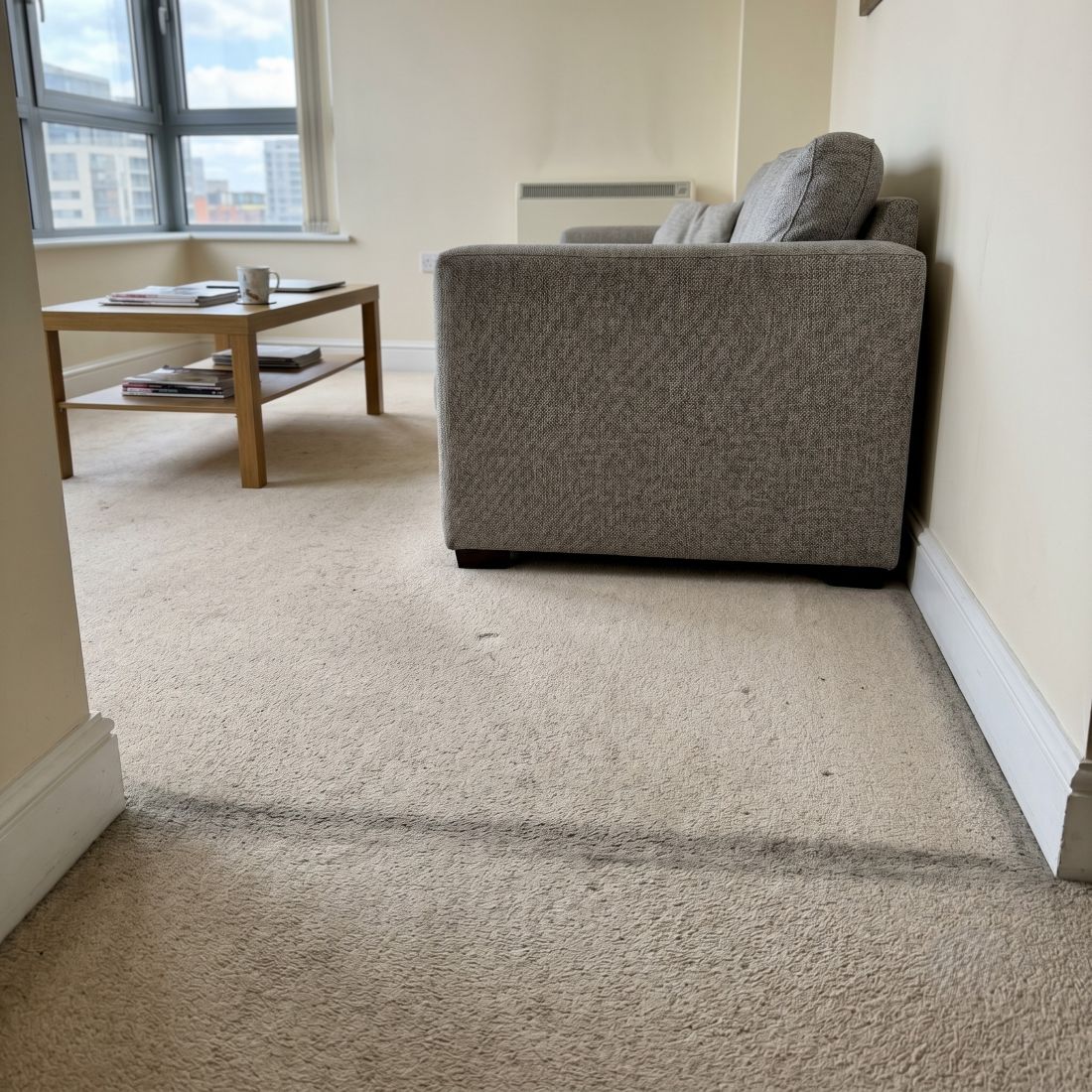
Here’s a scenario I know far too well. Someone has their carpet cleaned, or has a good go at it themselves, and a couple of days later it still feels faintly cool and damp underfoot. Then comes the smell – that flat, musty note that wasn’t there before and doesn’t seem to want to leave. They ring me, slightly baffled, asking whether the clean went wrong somewhere. More often than not, it didn’t. The clean was fine. The flat is the problem.
A carpet doesn’t really mind getting wet, as long as it can dry out again quickly afterwards. In a house with a back door you can fling open and a decent through-breeze, that happens easily enough. But a London flat is a different animal entirely. Tucked into a converted Victorian house, half sunk below the pavement, or sealed up tight in a modern block, a flat can hold onto moisture for days on end – and a carpet that stays damp for days is a carpet heading for trouble.
Why a Flat Holds the Damp In
Nowhere for the Moisture to Go
When a carpet is cleaned, a certain amount of moisture goes into it, and that moisture has to leave again – by evaporating into the air and then being carried off as that air moves and refreshes. The whole business depends on airflow. Move plenty of dry air across a damp carpet and it dries within hours. Trap that air in a still, humid room and the drying slows to a crawl.
A flat is so often exactly that still, humid room. Many have windows on only one side, so there’s no through-draught to speak of, just a single window you can crack open and hope for the best. The air that ought to be carrying the moisture away simply sits there, grows damper, and stops accepting any more. The carpet, meanwhile, stays wet.
The London Flat Problem in Particular
London adds its own special twist. So much of the city’s living space is carved out of older houses – garden flats half-sunk below pavement level, basement conversions, single-aspect flats whose only windows look onto a narrow light well. These are the homes that struggle the most. There’s frequently a touch of existing damp in the walls, very little in the way of cross-ventilation, and crucially no garden or outdoor space to drag a rug onto and let it air in the sun.
In a house, you’d sling a wet rug over the line for an afternoon and think nothing of it. In a third-floor flat off a busy road, where exactly do you put it? The honest answer for a great many Londoners is nowhere, and so everything has to dry indoors, in a space that wasn’t built for it.
What Slow Drying Actually Does to a Carpet
The Musty Smell and What’s Behind It
That musty smell is the first warning, and it’s worth taking seriously. A damp carpet left to sit becomes a comfortable home for bacteria and mould, both of which are perfectly content in the warm, moist, airless conditions a slow-drying flat provides. As they get going, they give off that characteristic stale, mildewy odour. People often reach straight for an air freshener, but the smell isn’t a surface problem to be masked over. It’s coming from something growing down in the pile and the layers beneath it.
Wick-Back: When Old Stains Rise Again
There’s a second problem, and anyone who’s read me before will have met it. When a carpet stays wet too long, the lingering moisture travels slowly upward through the fibres as it eventually dries, and it carries dissolved soil and old stain residue up with it. We call it wick-back. A carpet that looked immaculate on the day it was cleaned develops faint brown rings or patches a day or two later, seemingly out of nowhere at all.
In a well-ventilated room this is far less likely, because the carpet dries before the moisture has the chance to do it. In a flat where drying drags on for days, wick-back has all the time in the world. It’s one of the most common reasons I get called back to a carpet that supposedly “went wrong” after a clean, when in truth it simply never dried fast enough.
The Slow Damage Underneath
The part nobody sees is the underlay. Water sinks down into it and, in a poorly ventilated flat, can sit there long after the surface feels dry to the touch. Damp underlay is slow to recover and quick to turn musty, and over time that trapped moisture can break the material down and even encourage mould beneath a carpet that looks perfectly fine from above.
The fibres suffer as well. A carpet that dries slowly and unevenly can stiffen, clump and go a little grey, losing the soft, full feel it had before. None of this happens because the carpet was cleaned. It happens because it was left wet.
Why DIY Over-Wetting Is Riskier in a Flat
This is where those hired supermarket machines turn into a genuine hazard rather than just a disappointment. They tend to put a lot of water down and pull very little of it back out, leaving the carpet far wetter than it ever ought to be. In a house, you might get away with it by throwing the doors open and running a fan. In a flat, all that excess water has nowhere to go and nothing to carry it away.
So the carpet sits sodden for days, and every problem above – the smell, the wick-back, the damp underlay – becomes far more likely. I’ve been called to more than one London flat where an enthusiastic weekend shampoo left the carpet wetter for longer than any professional clean ever would, and the musty smell took weeks to shift afterwards. If you’re cleaning a carpet in a flat, the amount of water you leave behind matters more than very nearly anything else.
How a Pro Dries a Flat That Won’t Ventilate
Extract First, Wet Less
A professional approach treats drying as half the job, not an afterthought you deal with once the cleaning’s done. The first principle is simply to leave less water behind in the first place. Powerful extraction pulls the vast majority of the moisture straight back out, so the carpet starts off merely damp rather than soaked through. For flats that are especially difficult to dry, there are low-moisture methods that use a fraction of the water of a traditional wet clean, and they can be the sensible choice when you already know the ventilation is going to be poor.
Moving Air and Pulling Moisture Out
The second half of it is managing the room, not just the carpet. Air movers – essentially purpose-built fans – keep dry air sweeping across the surface so the moisture actually evaporates and lifts away rather than hanging about. A dehumidifier then takes that moisture back out of the air, which matters enormously in a sealed flat where there’s nowhere for the humidity to escape on its own. Between the two, you can dry a carpet properly even in a basement flat with one small window. It isn’t magic. It’s just understanding that in a flat, the air needs every bit as much attention as the carpet.
I had a garden flat in a converted terrace last winter where an earlier clean had left a musty smell that simply wouldn’t budge. One window, north-facing, no garden, and an old carpet that had never properly dried. A careful low-moisture clean with a dehumidifier running overnight sorted it out in the end – but it needed the whole room handled, not just the carpet on the floor.
What You Can Do to Help It Dry
If you’re faced with a damp carpet in a flat, a few things genuinely help. Get as much air moving as you possibly can – open whatever windows you have, and stand a fan or two blowing across the carpet rather than up at the ceiling. If you own or can borrow a dehumidifier, run it; in a flat, it’s worth its weight in gold. Keep the heating ticking over gently, since warm air holds and shifts moisture far better than cold. And resist the urge to put the furniture back too soon, because a sofa parked on a damp carpet traps the moisture underneath it, and that is exactly where the musty smell tends to start.
Above all, go easy on the water in the first place. A lighter, well-extracted clean that dries in hours beats a heavy soaking that lingers for days, every single time.
The Bottom Line
A carpet that won’t dry in a London flat usually has very little to do with the carpet or the clean, and almost everything to do with the room it’s sitting in. A flat with poor ventilation simply can’t shift moisture the way a house can, and a carpet left damp for days will smell, wick its old stains back up, and slowly suffer underneath where you can’t see any of it happening.
The good news is that it’s entirely manageable once you understand the cause. Use less water, move plenty of air, pull the moisture back out, and be patient with it. Treat the drying as seriously as the cleaning, and even the trickiest little garden flat can have carpets that come up fresh and stay that way – rather than ones that never quite recover from their last wash.