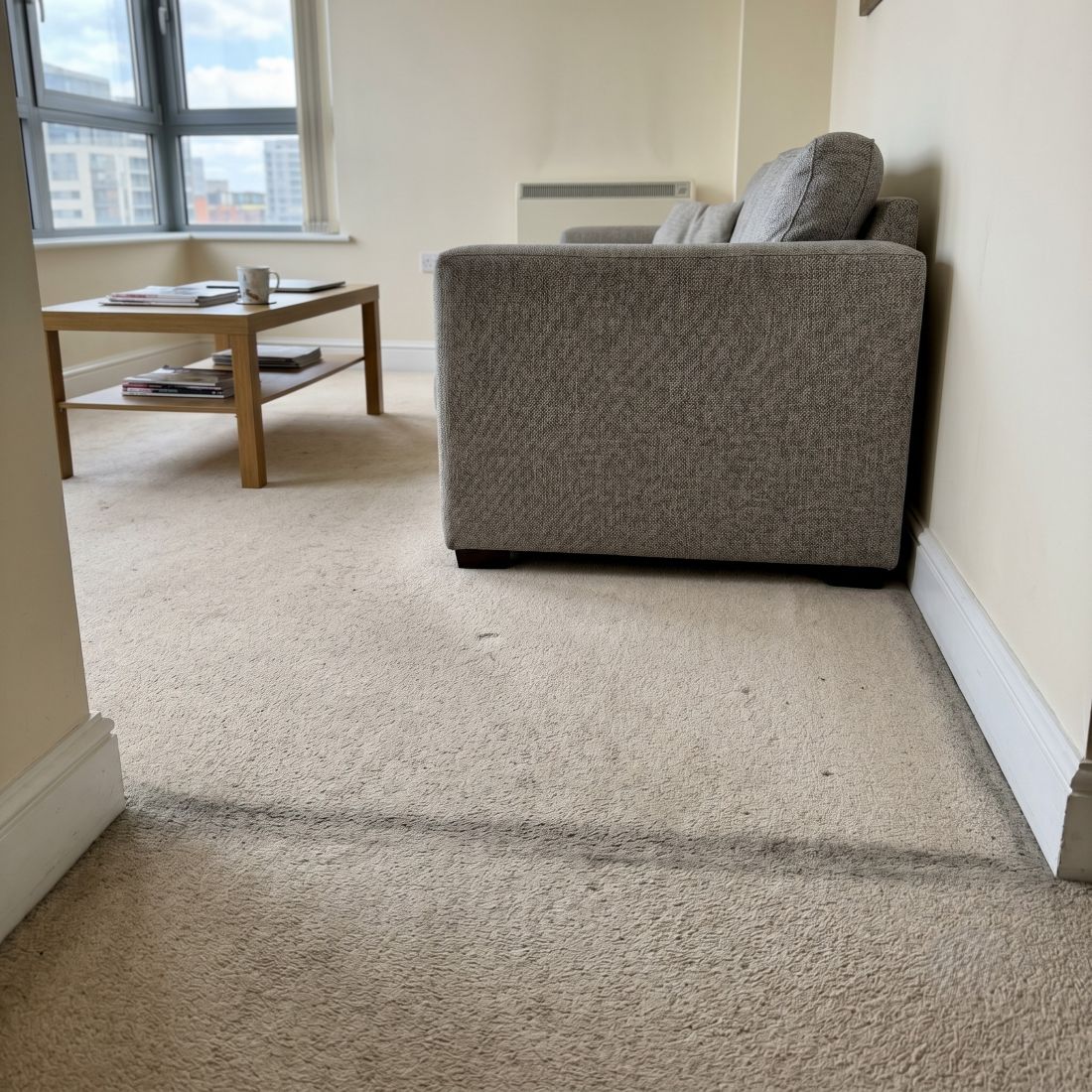
There’s a particular phone call I get that always starts the same way. “I’ve scrubbed and scrubbed at these black lines round the edge of my carpet and they simply won’t shift.” You can hear the frustration down the line. People have usually been at it for weeks – on their hands and knees with a brush and a bottle of something, convinced that if they just try a little harder the marks will finally lift. They almost never do.
Those dark grey lines tracing the skirting boards, creeping out from under the doors, running up the edges of the stairs – they’re one of the most misunderstood things I come across in London homes. The instinct is to treat them as ordinary dirt and go at them hard. But they aren’t ordinary dirt, and going at them hard is precisely the wrong approach. Once you understand what they actually are, the whole thing makes a great deal more sense, and you can stop wasting your weekends on a battle you were never going to win with a scrubbing brush.
It’s Not Dirt – It’s a Filter Doing Its Job
Your Carpet Is Quietly Filtering the Air
Here’s the bit that surprises people. Those black lines aren’t really about cleanliness at all. They’re about airflow. Air is constantly on the move around your home, and wherever it can’t escape easily through a door or a vent, it goes looking for the next best way out – through the tiny gaps where the carpet meets the skirting board, or under a closed door, or along the edges of the stairs.
As that air squeezes through the very edge of the carpet, the carpet does exactly what a filter does. It catches the fine particles the air is carrying and holds onto them. Day after day, month after month, those particles build up in a neat line precisely where the air is passing through. That’s why the marks are so straight and so stubbornly tied to the edges. The carpet has been filtering your air for years, and that black line is simply everything it managed to catch.
Why the Lines Land Exactly Where They Do
This is also why the pattern is so predictable. Filtration lines show up wherever air is forced through a gap under a bit of pressure: along the perimeter of a room against the outside walls, under doors that stay shut, at the foot of the stairs, and into the corners. Air takes the path of least resistance, and the edge of the carpet is very often it.
If you’ve ever wondered why the middle of the carpet looks perfectly fine while the edges look filthy, there’s your answer. The middle isn’t where the air is escaping. The edges are.
Why London Makes It Worse
A City With Plenty in the Air
Filtration soiling needs two things to get going: moving air, and something in that air to catch. London supplies the second in abundance. The capital’s air still carries a heavy load of fine particles, a great deal of it thrown up by traffic, and every single borough sits above the level the World Health Organisation recommends. Schemes like the ULEZ have helped to bring things down, but there’s still plenty of soot and grime drifting about, particularly in the more central areas.
And it isn’t only what blows in from outside. Burning candles, cooking, an open fire, the odd cigarette – all of it puts fine, greasy particles into the indoor air as well. Your carpet doesn’t care in the slightest where the particles came from. It filters the lot.
Draughty Old Houses and Gappy Floors
London’s housing stock does the rest. So many homes here are period properties with suspended timber floors, original skirting boards, and doors that have never quite sealed. All those lovely old gaps hand the air endless little routes to travel through, which is exactly what filtration soiling feeds on. Newer homes are often built with seals at the base of the walls that cut the problem right down, but the Victorian terrace I’m so often called out to has gaps in all the classic places. Plenty of air movement, plenty of particles, and plenty of edges for the carpet to filter at – it’s a perfect storm for black lines.
I cleaned a first-floor flat in a Victorian conversion right on a busy main road where the lines around the bay window were nearly jet black. Heavy traffic outside, old single-glazed sashes, and gaps in all the usual spots – that carpet had been quietly catching the road’s worth of soot for a decade. It’s some of the most dramatic filtration soiling I’ve seen, and the owner had no idea what it even was.
Why Scrubbing Won’t Work
The Particles Are Bonded On, Not Sitting On Top
Now to the heart of it, and the bit that saves you a lot of wasted effort. The reason you can scrub at a filtration line all day and barely make a dent is that the soil isn’t sitting on top of the fibres waiting to be wiped away. It’s bonded to them.
These particles are extraordinarily fine – far finer than ordinary household dirt – and they’re often greasy or oily, which makes them cling for dear life. On top of that, they carry a static charge that effectively glues them to the carpet fibres and to one another. They work their way deep into the pile, sometimes right down into the backing. Some of the soil is water-based and some of it is oil-based, which is exactly why no single household spray ever seems to touch it. You aren’t cleaning a surface. You’re trying to release something that has both chemically and physically attached itself to the carpet.
Vacuums and Brushes Are Fighting a Losing Battle
Your vacuum is little help here either, and not because you’re doing anything wrong. Vacuums simply have very weak suction right at the edges, since nearly all their pull is concentrated in the middle of the head. A crevice tool gets you a touch closer, but it still can’t lift soil that’s bonded on this tightly.
Scrubbing, meanwhile, is worse than useless. Beyond failing to shift the soil, a stiff brush frays and fuzzes the delicate edge of the carpet pile, so you end up with a damaged, fluffy line sitting on top of the dark one. I’ve seen plenty of carpets where the scrubbing did more lasting harm than the soiling ever would have on its own.
What Actually Shifts It
What a Specialist Approach Involves
Getting filtration lines out is a proper job, and an honest cleaner will tell you it takes specific products and a fair amount of patience. The soil generally needs breaking down with the right agents – something to tackle the oily side of it and something for the water-soluble side – worked gently into the fibres and given time to do its work before being extracted back out. It’s careful, fiddly work right along the very edges, and it takes far longer than cleaning the open floor ever does.
It’s worth knowing, too, that not every carpet cleaner tackles this sort of thing well, and many treat it as an added extra because of the time it swallows. If filtration lines are your main concern, it’s a perfectly fair thing to ask about directly before any work begins.
The Honest Bit About Results
And here’s where I’ll level with you, because managing expectations matters as much as anything. Filtration lines can usually be improved a great deal, and very often they come up far better than the owner ever dared hope. But they can’t always be removed completely. When those oily particles have been baked into a light-coloured fibre for years on end, they can permanently stain it, and no amount of skill will bring it back box-fresh. A good clean lifts most of it and makes the edges look dramatically better. Perfection isn’t always on the table, and anyone promising it isn’t being straight with you.
Keeping It From Coming Back
You can slow filtration soiling right down once you understand what drives it. Vacuum the edges and corners regularly with the crevice tool, because the less time the soil has to bond, the easier it is to manage. Cut down on the indoor sources where you can – run the extractor fan when you cook, go easy on the candles, and don’t smoke indoors. Air the rooms out properly each day. And if you’re at all handy, sealing the gaps under the skirting and around the floor edges reduces the airflow that causes the whole thing in the first place.
None of this is about cleaning harder. It’s about giving the carpet less air to filter and fewer particles to catch.
The Bottom Line
If you take one single thing from all this, let it be that black lines around your carpet are not a sign of a dirty home or a failure on your part. They’re physics – the simple result of air, gaps, and a city with a great deal in its air. Scrubbing won’t beat them, and it may well make them worse.
Understand what they are, ease off the brush, keep on top of the edges, and bring in someone who knows how to treat filtration soiling properly once it’s built up. Your carpet has spent years quietly doing the work of cleaning the air you breathe. The least we can do is treat the evidence of it with a bit of the right knowledge.